The abyss of our planet holds mysteries that are as fascinating as they are varied. In this inhospitable environment, species evolve away from prying eyes, adapted to extreme conditions of pressure and darkness. These often-unknown creatures challenge the imagination with their unique appearances and behaviors. From lanternfish to Dumbo octopuses, not to mention bioluminescent jellyfish and giant hydrothermal vent worms, these living beings are witnesses to the biodiversity hidden in the aquatic depths. Their study contributes to our understanding of the limits of life on Earth and even inspires science fiction.
The luminous sentinels of the abyss
In the oppressive darkness of the ocean depths, some species have developed luminous strategies to survive. Marine creatures of astonishing biodiversity, they fascinate scientists and literally illuminate our knowledge of abyssal marine life. Among them, the Vampyroteuthis infernalis, commonly known as the vampire squid, stands out. This species lives between 500 m and 3000 m deep, in an environment where sunlight does not penetrate. It possesses electroluminescent organs that allow it to attract organisms or communicate in the ink of the abyss.
Next, we have the Chondrocladia lyra, a carnivorous lyre sponge that has chosen to settle more than 3 km deep in the Pacific Ocean. Its poetic name conceals a very pragmatic reality: it uses hook-like spicules to capture small prey, demonstrating a formidable adaptation to the constraints of its habitat. Its cousin, Chondrocladia lampadiglobus, shares similar characteristics, populating the deep waters of the southeastern Pacific with the same predatory efficiency.
Our journey into the heart of the aquatic darkness brings us to meet species that have forged close ties with their environment. The vampire crab, for example, although it does not belong directly to the realm of the luminescent, is another fascinating entity of these depths. Its ghostly gait and delicate claws evoke the creatures of the darkest tales, a biological reality woven into the complex tapestry of the abyssal food chain.
These sentinels of the depths, with their extraordinary adaptation capabilities, are privileged subjects of study for understanding the resilience of life in extreme conditions. Their existence highlights the richness of biodiversity and the necessity to preserve these fragile and unknown ecosystems. Luminous species, with their unique biological properties, are landmarks that guide science in exploring underwater mysteries.
The invisible architects of the oceans
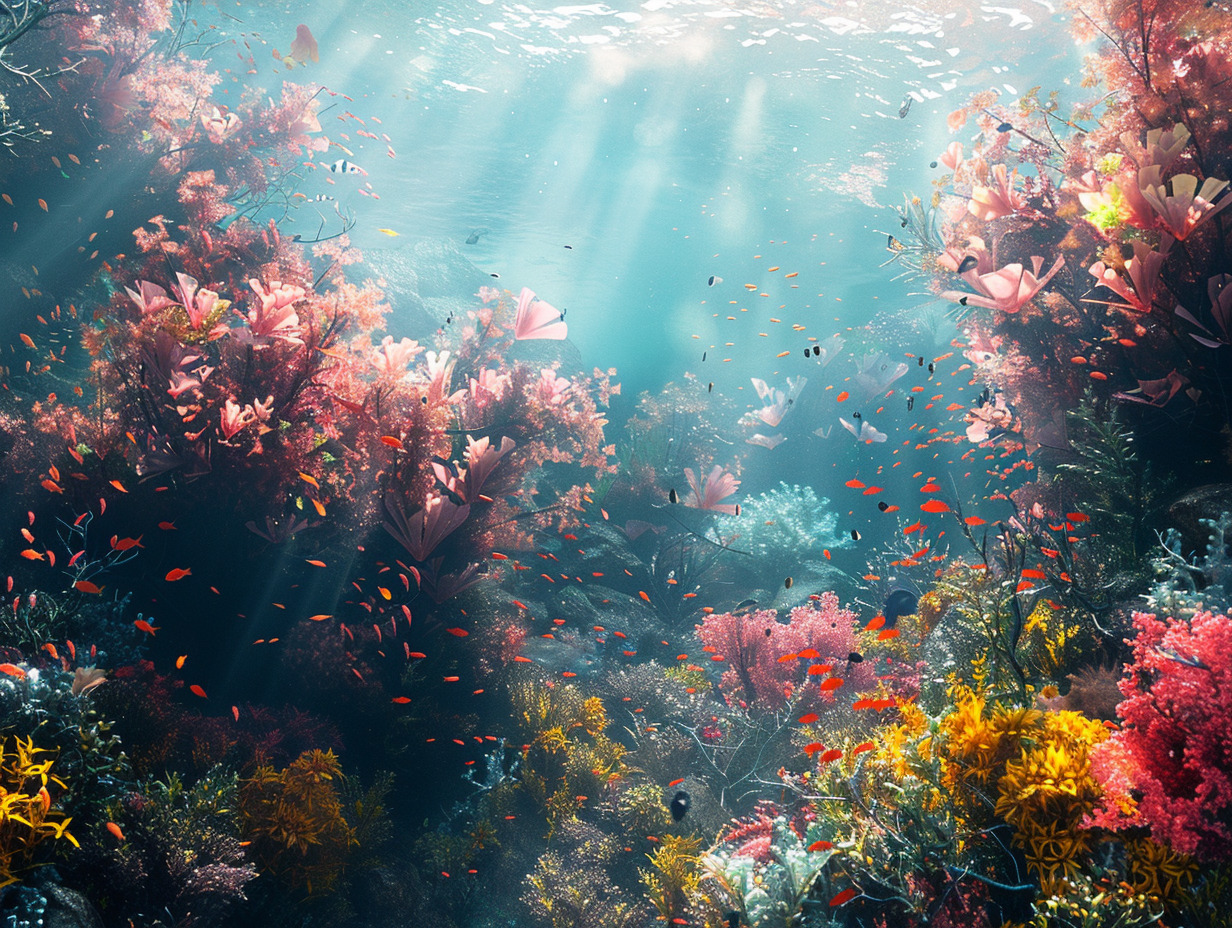
Beyond coral reefs, true cathedrals of marine biodiversity, lie invisible architects that shape the ecosystem in the silence of the abyss. The Rimicaris exoculata, a hydrothermal shrimp from the depths of the Atlantic, lives more than 2000 m deep. It hosts microorganisms in its head, which, in symbiosis, provide an essential food source. Consider this shrimp, whose survival depends on such mutualism, as an emblematic example of the ingenuity of life in the most hostile environments.
Marie Anne Cambon-Bonavita, a specialist in extreme environment microbiology at Ifremer, studies these unknown communities that play a crucial role in regulating marine ecosystems. These often-overlooked microorganisms are the invisible engine of underwater life, transforming toxic chemical elements into nutrients. Follow Cambon-Bonavita’s work to grasp the scope of these discoveries that reshape our understanding of the marine world.
The Macropinna microstoma, with its tubular eyes housed in a transparent dome, and the Goblin Shark, with its long flattened snout equipped with Lorenzini ampoules, illustrate the diversity of adaptations among abyssal species. The former can retract its eyes to track its prey, while the latter uses its electrosensory capabilities to detect the magnetic fields of its victims. Laure Bonnaud-Ponticelli from the National Museum of Natural History emphasizes that these adaptations are a testament to millions of years of evolution, revealing sophisticated predation and survival mechanisms. These creatures, often relegated to the status of curiosities, are the keystones of their habitat, essential architects of the balance of their ecosystem.